Start with why you are asking
The most useful preparation for an older-home wiring assessment is a clear description of the decision you need to make. A buyer reviewing an inspection report, an owner responding to an insurer and a renovator preparing to close walls may all be looking at similar components for different reasons. The assessment should be defined around that question and the property.
Watt Cleveland Knob and Tube offers and manages older-home electrical assessment and replacement work in Cleveland and nearby communities, with electrical work performed by fully licensed and insured contractors. You do not need to diagnose the system before making contact. Provide the location, building type and the event that raised the concern so the first discussion has a useful starting point.
Collect existing documents before collecting more photographs
An inspection report can identify where wiring was observed and what the inspector recommended. Share the full relevant wording and photographs rather than a short paraphrase that may omit a limitation. A report noting suspected K&T is not necessarily a statement that every photographed conductor was confirmed active.
For insurance, obtain the carrier’s written request and any stated deadline. Establish whether it asks for an assessment, specific corrective work, complete replacement or completion records. Those requests can lead to different scopes, and an electrician should not have to guess which one applies from the phrase insurance letter.
Previous electrical proposals, permits and completion descriptions can also help. Records naming circuits or rooms are more informative than a general statement that the house was updated. A new panel invoice does not establish that the branch wiring was replaced. Keep uncertain history identified as history rather than turning it into an assumed fact for the estimate.
Photograph context only when it is safe
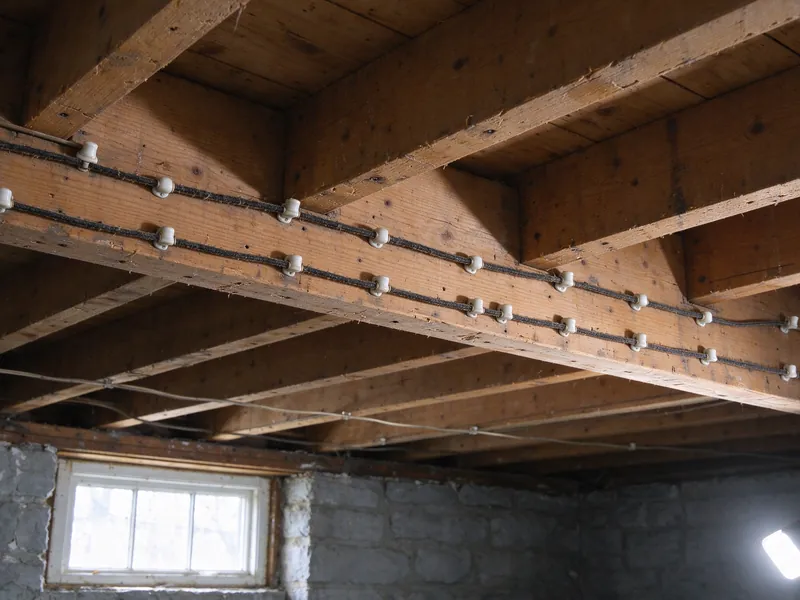
A photograph from a normal safe position can show the room, accessible space or visible component that prompted the request. Wider context can be useful for understanding access. A close image of porcelain alone may not show whether the space is an attic, basement or opened wall within a renovation.
Do not remove covers, unwrap connections, pull conductors, move insulation or enter an unsafe area to improve the evidence. Material that looks sound can be fragile when disturbed, and appearance cannot establish electrical status. A photograph is preparation for professional evaluation, not a substitute for it.
If you do not have photographs, explain what the report or person who noticed the wiring said. The contractor can discuss what information is useful and what belongs to the assessment. Being unable to safely reach a location is an access fact worth sharing, not a problem the homeowner should solve by taking risks.
Describe the building and access limitations
Mention whether the property is a single home, an apartment, a two-family building or a commercial space. Identify which unit or area is involved and who can authorize access to shared or adjacent spaces. The requested scope should not imply a building-wide conclusion if only one unit can be reviewed.
Explain known renovations, finished attic rooms, basement ceilings and areas unavailable during the visit. These details can affect what can be established through existing access and which replacement routes might be considered. An open basement does not prove there is a clear path to every upper-floor fixture.
Tell the contractor which finishes you want retained. Trim, wallpaper, decorative plaster or recently painted rooms, where present, can influence the access discussion. You are not deciding the wiring route yourself; you are providing the priorities that should be considered before an opening becomes part of the plan.
Ask what the visit is intended to deliver
An electrical assessment, written findings record and replacement proposal are related but distinct deliverables. Ask what the agreed visit includes and what could require further investigation. A useful record explains the observed condition, the relevant circuit questions and the limits of accessible work.
If active and abandoned wiring need to be distinguished, state that objective. If an insurer wants evidence that no active K&T remains within a defined property, provide its wording before assuming a brief visit can establish the result. Concealed conditions can limit what can be confirmed without additional access.
Ask how those uncertainties would be handled. The contractor should describe what remains unanswered and what further investigation would involve, rather than burying the limits in a broad assurance that the electrical system was checked. This makes the findings useful for the next decision without overstating their reach.
Prepare household and project information
Share any planned appliances, renovation drawings or insulation proposal that affects the work. A new load, an opened wall and a future attic handoff can change the scope discussion. Equipment changes such as a panel upgrade should still be explained separately from branch-circuit replacement.
If residents remain, identify power-dependent activities, access restrictions and room-use needs. The contractor can discuss expected interruptions after understanding the project. Do not assume daily restoration of every circuit or a fixed completion interval from a preliminary conversation.
Finish by confirming the intended next step: clarification of the findings, a defined partial proposal or planning for broader replacement. Keep the resulting records with the documents you supplied. Good preparation does not mean proving the wiring condition yourself. It means giving the professional enough context to investigate the right question and explain an honest scope.
Questions about this decision
Do I need to identify the wiring type before requesting a visit?
No. Describe what was observed and share existing reports. Porcelain supports, cloth covering and newer cable can require professional interpretation, especially in mixed systems.
Should I open the panel so the contractor can see it in a photo?
No. Do not remove equipment covers or expose wiring to prepare. Share safe existing views and let the contractor decide what access is appropriate during the assessment.
What if the report does not say whether the wiring is active?
Keep that uncertainty clear. Ask the assessment to address the relevant active-versus-abandoned question within its agreed scope, and to state any concealed or access limits.