Compare the endpoint first
Compare rewiring quotes by the circuits replaced, equipment changes, access assumptions, finish repairs and completion records they include. Similar totals can describe different outcomes, while different totals can reflect different responsibilities. The phrase full rewire is not enough to establish that two proposals cover the same work.
Watt Cleveland Knob and Tube offers and manages older-home electrical work in Cleveland and nearby communities. Electrical work is performed by fully licensed and insured contractors.
Begin with the reason you requested estimates. If the objective is removal of all active K&T within the agreed property scope, each proposal should address that result. If the job concerns a defined circuit group, make sure the quote does not imply an entire-house outcome that the assessment never established.
Read the circuit description as the core of the proposal
Look for the outlets, lighting points, circuit groups or building areas included, along with a description of what remains. Modern circuits may be retained in a K&T replacement project. A broader whole-house rewire may include new layout choices or additional circuits, which should not disappear into the same vague label.
Ask how the contractor established the boundary. A quotation based on accessible observations can be useful when its limitations are stated, but it is different from a scope following more extensive investigation. Where concealed connections remain uncertain, note the assumptions and change procedure. The lowest apparent price can leave that investigation outside the total.
Separate supporting equipment from branch replacement
A panel or service upgrade can form part of a project without being required for every older house. Ask why it is included, what condition or capacity question it addresses and whether utility coordination affects the schedule. A larger panel alone does not supply new wiring to every room.
Compare grounding, protective devices, boxes and final connections on the same basis. One proposal may include additional appliance circuits or receptacle locations the other does not. Those differences may be worthwhile, but they should be visible choices. The owner should be able to distinguish required replacement work, supporting changes and optional improvements before deciding which price is better value.
Find the access assumptions
A contractor may expect to reach rooms from an unfinished basement or attic. Another may allow for openings in finished surfaces. Ask what has been assessed and what happens if an intended route is blocked. Construction details, additions and previous renovations can affect the path independently of the home's square footage.
A no-damage promise deserves explanation, especially when concealed routes are unresolved. Conversely, a proposal allowing openings should describe anticipated locations and the finishing responsibility. The comparison is not simply which contractor predicts fewer holes. It is whether each access plan is realistic, scoped and connected to a clear procedure for discoveries.
Define the finishing point in ordinary language
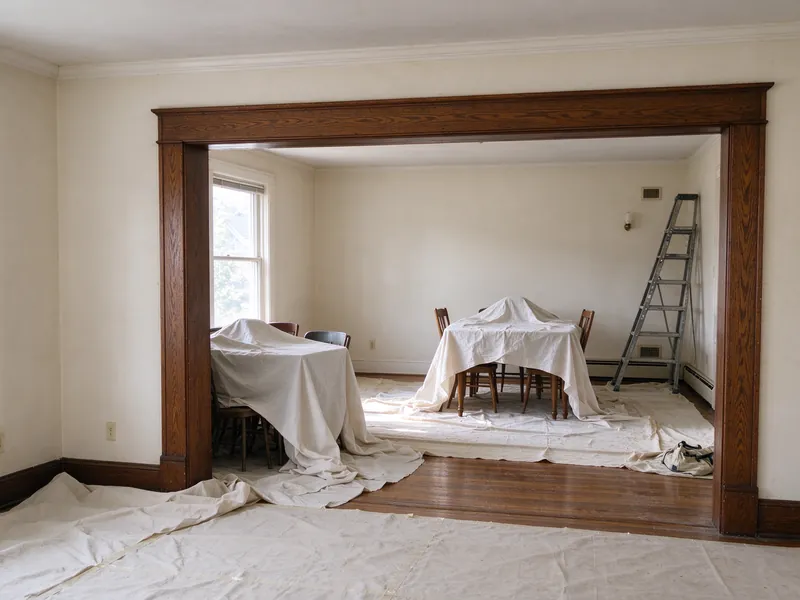
Electrical completion can leave work for another trade. Closing an opening, matching plaster, priming and painting are distinct tasks. A quote including basic patching is not equivalent to one covering finished decoration, and a quote excluding restoration entirely needs a separate finishing budget.
Ask whose contract covers furniture protection, debris handling and any special finish requirements. Wallpaper, decorative ceilings and retained trim can affect the conversation. Describe those priorities before the estimate is finalized so the bidder can consider the actual surfaces. Do not assume that the word patching means the room will look exactly as it did before the work.
Compare scheduling and change procedures
Read how power interruptions, occupancy and access arrangements are described. A proposed installation duration is not necessarily the total period needed for assessment, permits, inspections and restoration. Identify dependencies on the municipality, utility and other trades rather than comparing only a stated number of working days.
Ask how additional work is approved. A useful change process identifies the finding, proposed response and effect on cost or timing. An unexplained allowance or broad exclusion can shift uncertainty to the owner. That does not automatically make a quote unsuitable, but the risk needs to be understood before comparing it with a more fully assessed scope.
Check the records and the contractor behind the work
The handover should describe the work completed and any retained legacy wiring, with applicable permit and inspection information. If an insurer requires particular records, give both bidders the written request. Neither a larger price nor a permit guarantees that the carrier will accept the evidence.
Watt Cleveland Knob and Tube offers and manages rewiring through fully licensed and insured contractors. When requesting an estimate, share the same building information, reports and required endpoint with each bidder. Compare their written responses side by side, and resolve ambiguous inclusions before deciding. A price is most useful when you can explain what it buys and what still needs to be arranged.
Questions about this decision
Should I compare a price per square foot?
Not as the deciding measure. Access, circuit count, equipment and finish work do not scale evenly with floor area. Compare the actual inclusions and retained conditions first.
Is the proposal with a panel upgrade automatically better?
No. Ask why the upgrade is proposed and how it relates to the branch circuits. It may be necessary or useful, but it is a separate scope decision rather than proof of a more complete rewire.
What if one quote leaves painting to me?
Record that exclusion and obtain the finishing scope needed for the same endpoint. Compare the combined responsibilities rather than treating the electrical totals as equivalent finished-room prices.