Electrical status is the essential difference
Active knob and tube remains part of an energized electrical installation. Abandoned material has been taken out of service, but conductors or porcelain hardware may still be physically present. A visual observation alone does not reliably distinguish the two. A qualified electrician must establish the relevant connections and status within the agreed assessment.
Watt Cleveland Knob and Tube offers and manages older-home electrical work in Cleveland and nearby communities. Electrical work is performed by fully licensed and insured contractors.
That distinction changes the work being discussed. Replacing a circuit that still supplies rooms is different from removing disconnected scraps. An insurer may also ask for a particular endpoint that is broader than the visible finding. Keep the condition of the electrical system separate from the amount of old material you can see.
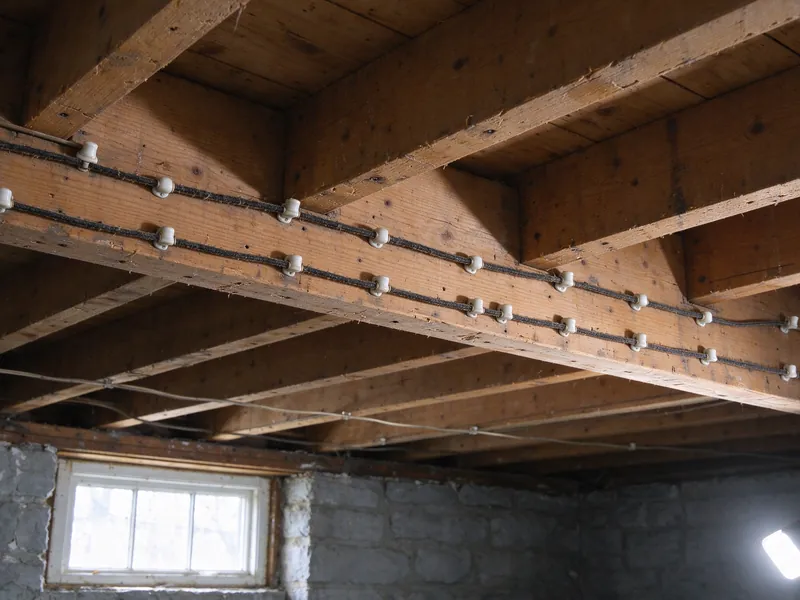
Why abandoned components can remain
Porcelain supports are attached to the building, and old conductors may extend behind intact finishes. Taking every component out can require access work beyond what is needed to retire and replace an active circuit. A completed rewire can therefore leave physical remnants where the agreed scope and applicable requirements permit them.
This does not mean every leftover wire can be ignored. The condition has to be verified, and the treatment should be consistent with the project requirements. A disconnected section documented during one job does not establish that every similar section elsewhere was also disconnected. Records need to identify the inspected area and electrical boundary, especially when different contractors or owners have worked on the house over time.
Mixed wiring makes shortcuts unreliable
An older home can have new cable, old separated conductors and devices installed during several renovations. A new section may connect to retained wiring beyond view. A modern panel may supply circuits that were never replaced. These arrangements are reasons to trace relevant circuits rather than infer status from a single visible end.
Broken-looking wire, dust or an apparently unused fixture is not proof of abandonment. Likewise, the fact that a room has working lights does not identify which wiring supplies them. Describe the observations accurately and let the assessment establish their significance. Do not pull loose material, remove insulation or operate equipment as an investigation method. The uncertainty itself belongs in the request for professional evaluation.
Define what the visit will establish
Tell the contractor why active status matters. You may need to plan insulation, understand a purchase report or verify a previous replacement claim. Each objective can require a different breadth of investigation. Checking one accessible run is not equivalent to assessing every branch circuit in a house.
Ask whether the proposed assessment includes tracing the affected circuits and a written findings record. It should explain accessible areas reviewed, established status, connections requiring attention and unresolved concealed routes. Where access prevents a complete answer, identify what further work would be necessary. A qualified limitation is useful information for budgeting and scheduling; it should not disappear from the report simply because the owner wants a definitive answer.
Match the removal request to the real objective
For demolition, physical removal may be needed because the building area is being opened anyway. For an occupied home with retained plaster, unnecessary extraction may create additional restoration work. For an insulation project, the condition of conductors in the affected area and the requirements governing that project need to be resolved before the next trade proceeds.
The word removal should therefore be unpacked in the proposal. State which circuits are being replaced or retired, which accessible conductors will be removed and what verified disconnected material may remain. If a carrier or other party has requested removal, obtain its exact wording before choosing the scope. Do not assume that its meaning matches the contractor's ordinary use of the term.
Keep completion claims as precise as the assessment
A record for partial work should identify the circuits replaced and the old wiring left in service. A record for full K&T replacement should address the remaining legacy system within the agreed property scope. Neither should claim that every physical support was removed unless that work actually formed part of the job.
Retain the proposal, applicable permit and inspection records, and the contractor's completion description together. If abandoned material is discovered later, those records can help another electrician understand the earlier work without treating every remnant as a new whole-house failure. Watt Cleveland Knob and Tube manages assessment and replacement through fully licensed and insured contractors. Begin with the report or area that prompted the question, and ask for an endpoint the findings can actually support.
When records refer to abandoned wiring, ask whether the description applies to a particular run, a circuit group or the entire agreed property scope. A broad label copied from an earlier invoice may obscure that boundary. The distinction is especially important when later renovations uncover material outside the area previously assessed.
Questions about this decision
Can a loose end be treated as abandoned?
No. Its appearance does not establish the complete circuit or electrical status. Leave it undisturbed and arrange professional identification rather than attempting to verify it yourself.
Does abandoned wiring have to be physically removed?
The appropriate treatment depends on the project, access, agreed removal scope and applicable requirements. Disconnecting a circuit and extracting every concealed component are separate tasks. Clarify both before comparing prices.
What if a report only says old wiring remains?
Ask whether the statement means active wiring, disconnected material or an unverified visual finding. If that distinction was not established, a further electrical assessment may be needed before a replacement proposal can be defined.